
This New Pyramid Theory Explains the Missing Evidence
The new top down theory

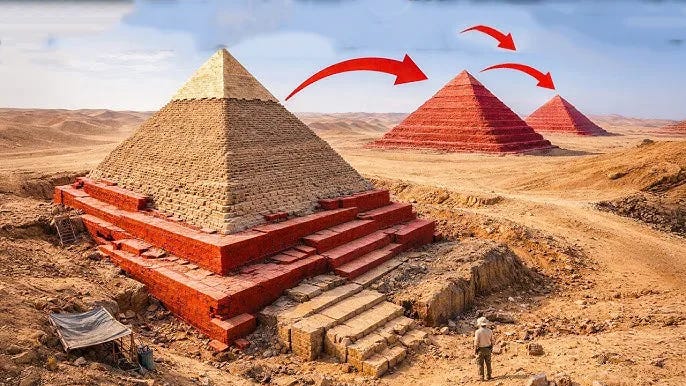
I’ve been obsessed with pyramid construction theories for years. Not because I think aliens built them, though that would make things simpler in a weird way. But because every theory we have falls apart somewhere. Usually at the top.
The external ramp theory has obvious problems. The internal ramp theory looked promising until the scans showed it probably isn’t there. The water theories can’t explain the missing infrastructure. Every single approach runs into the same wall: we’re missing evidence. Critical evidence. The kind of evidence that should be everywhere if any of these methods were actually used.
But what if the evidence isn’t missing? What if it’s been misinterpreted this whole time?
That’s what this new theory suggests. And honestly, it’s the first explanation I’ve encountered that actually makes the missing evidence make sense.
The Problem Every Theory Has to Solve
Before we get into the new theory, let’s talk about why pyramid construction is such a pain in the ass to explain.
The Great Pyramid is 146 meters tall. 2.3 million blocks of stone. The base is almost a perfect square, off by mere centimeters. The slope is so razor precise that even the slightest variation would mean failure at the top. The whole thing is aligned almost perfectly to true north, off by just 1/15 of a degree.
They did all of this without compasses, lasers, or GPS. As far as we know, they used nothing but the stars.
And the real nut that needs to be cracked? The apex. That sharp point at the top is actually the hardest part of the entire structure to explain. Because even a tiny error at the base becomes massive deviation at the top. The edges need to be perfectly straight, which means you need full access to all four faces and lots of room to work.
Most pyramid construction theories actually work fine… until you reach the top. Then they fall apart.
The External Ramp Theory and Why It Doesn’t Work
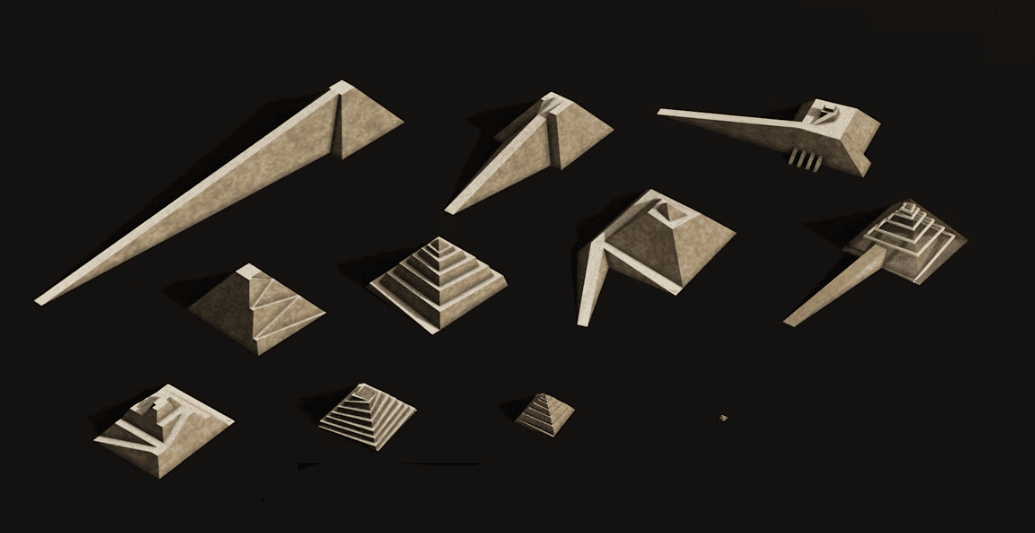
The classic theory: workers dragged blocks up a huge external ramp as the pyramid rose. Simple in theory.
But to keep the slope gentle enough for normal humans and not Olympic athletes, the ramp would need to stretch around two kilometers. Anything shorter or steeper and people probably start dying on you.
By the time you’ve built a ramp that’s safe to walk on, you’ve basically used more materials and labor just to build the thing that builds the thing. And the real killer? There’s zero archaeological evidence of a mile long ramp ever existing or being torn down.
Then there’s the spiral ramp variation. A ramp spiraling around the pyramid, shorter and more compact, reusing the same slope over and over. But now you have a different problem.
The faces of the pyramid need to be perfectly straight. Otherwise the edges can’t meet at the apex. To keep the precise angle, the builders had to constantly check the edges. But with a fat ramp in the way, it’s blocking all the corners you need access to.
And when you get near the top, you eventually have to remove the ramp or drastically shrink it right when you need it most. That’s not ideal.
The Internal Ramp Theory and the Fox
In the 1980s, someone saw a fox entering the Great Pyramid near the base and somehow popping out hundreds of feet higher. That little fox inspired French architect Jean Pierre Houdin to propose a hybrid system.
A short external ramp made of limestone for the first third of the structure, which is then reused for the top part once it’s done. Then a hidden ramp spiraling inside the structure.
It very neatly explains the missing debris. It even answers some mysteries around the Grand Gallery, which Houdin thinks was a giant counterweight system for hoisting the granite beams found in the King’s Chamber. It explains why the gallery is so tall and narrow and lined with strange benches and covered in scuff marks, as if something hard and heavy slipped through it over and over again.
It’s elegant. I wanted it to be true.
But then in 2015, the pyramids got a giant CT scan using muon tomography. Think of muons as high energy particles from space constantly raining down on Earth. They pass through rock, but very dense areas slow them down. Put detectors inside and around the pyramid, wait long enough, and you can build a 3D density map without touching a single stone.
They found something crazy: a massive, unexplained void just above the Grand Gallery. That led to thousands of new theories overnight.
But what they didn’t find was a clean spiral running just under the surface. If a kilometer long ramp was hiding there, you’d expect at least a faint trace. Instead, the scan shows scattered voids. It doesn’t necessarily kill the idea, but it strongly weakens the argument.
And with an internal ramp, the higher you get, the more you’re losing turning radius, hauling space, and the ability to check the edges. Same problem as the external ramp, just hidden inside.
Why the Apex is Everything
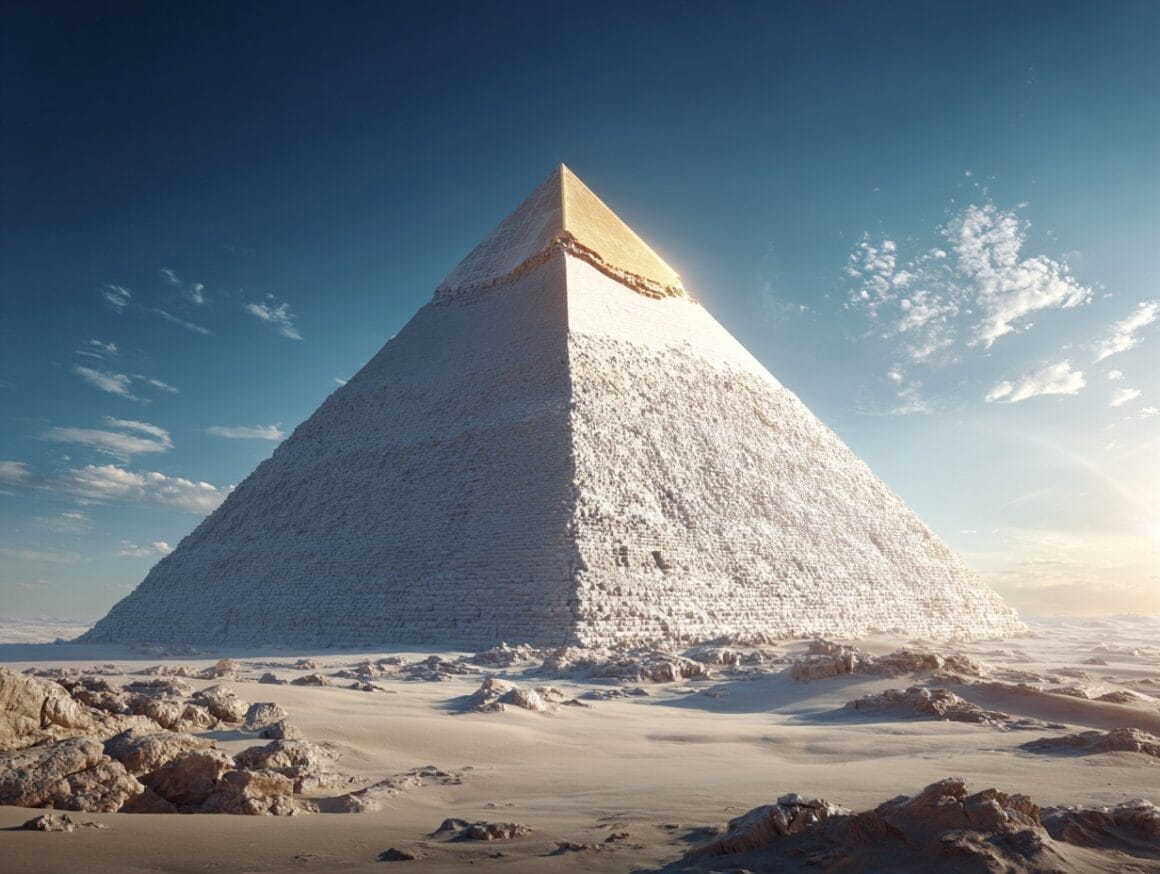
When you look at pyramids in other cultures, you start to notice a lot of them dodge the apex issue with a flat top. Even Egyptian pyramids from later dynasties lose their tips.
According to Egyptologist assessments, although pyramids were made all over the world, only the Egyptian pyramids are considered a miracle specifically because of that sharp apex. It’s the rarest and hardest part to explain.
That point at the top? That’s the key to understanding how they were built.
The Top Down Theory: Building by Unbuilding
About two years ago, someone sent the creator of that video an email with a theory. At first it seemed a bit conspiracy adjacent, but after reviewing almost ten years of research and thousands of hand placed 3D modeled blocks, the theory started making sense.
The guy’s name is Huni Choi. He’s not an architect. Not an Egyptologist. Just someone who spent a decade obsessively modeling every measurable stone at Giza.
His theory:
the Great Pyramid wasn’t built. It was unbuilt.
All the missing evidence we’ve been searching for… the ramps, the tools, the machinery… it’s not missing at all. It’s actually right in front of us. Just misinterpreted.
Let me explain. Before the Great Pyramid, there was a natural limestone outcrop with small hills. Most of the core blocks for Khufu’s pyramid were carried directly from this plateau, with finer casing limestone brought from Tura and granite from Aswan.
They used the landscape to their advantage. First, they identified the high points, shaved them, and terraced them, turning the hill into a working platform.
Then they overbuilt. Instead of starting with a pyramid shape, they created a rough, gigantic trapezoidal stacked mass with an integrated ramp system.
Once the ramp reached its full height, they started carving it down into the final pyramid shape.
Why This Solves the Apex Problem
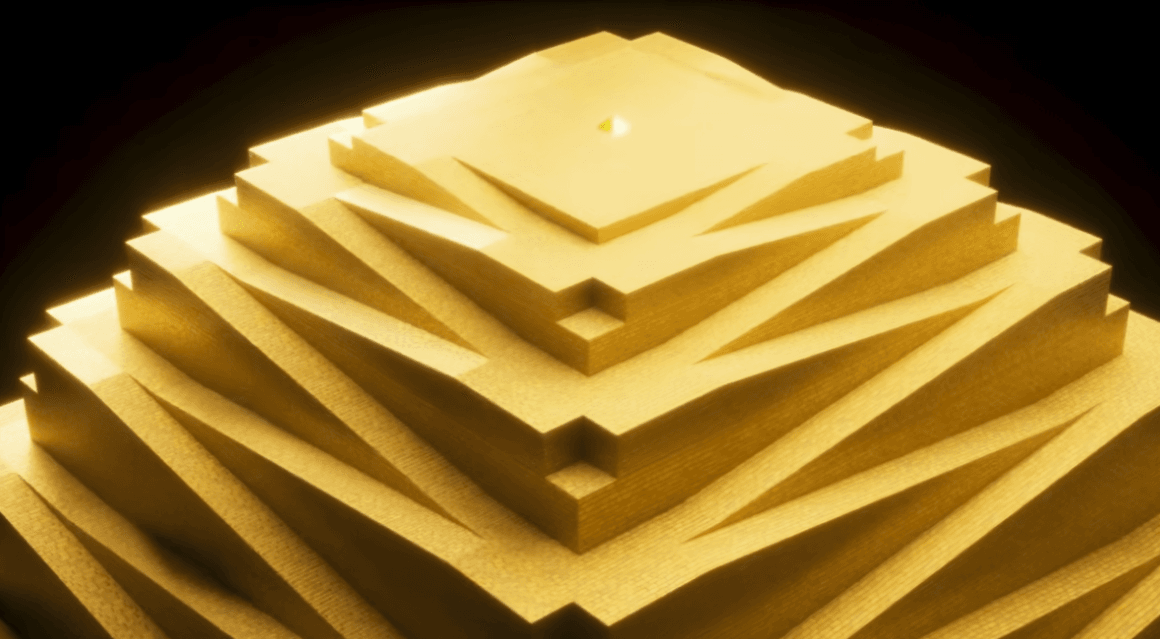
Remember the apex problem? Even the tiniest error at the base explodes into huge deviations at the top.
But if you work downward from a wide, stable platform, it’s much easier to retain the precise angle.
The shape is crucial here. If you applied this system to a pyramid shape from the start, the ramp would get steeper and higher as you go up, creating a death slide for workers.
But a trapezoid spreads outward at the top. It gives you a workable seven degree ramp all the way up, a flat safe working deck around the apex, and full visibility of all four edges as you carve the final geometry.
Instead of fighting the pyramid shape, you delay it until the very end.
The Recycling System
Once you carve down the stacked mass, the extra limestone is then reused for the other pyramids.
The Great Pyramid is roughly 6 million tons. Choi’s model estimates the initial stacked mass to be around 8 million tons. Carving that down gives you roughly 2 million tons of reusable stone.
This gets split between the working mass for Khafre’s pyramid and the other buildings. Then the process is repeated for the other pyramids, each one going through the same recursive construction loop.
Once you add all the stone that moves through this loop, you get around 14 million tons circulating through the system with roughly 1 million tons left over. Which weirdly lines up with mainstream volume estimates for the entire Giza complex.
What’s interesting is that this theory treats the entire plateau as a single construction engine. A closed loop system.
And it actually matches Egyptian behavior. Because the Egyptians were really into recycling. They turned broken boats into furniture. Broken furniture became small objects. Later dynasties literally mined old pyramids for new buildings.
A cannibalizing system for the pyramids feels like a very Egyptian thing to do.
Why the Evidence Disappeared
This led to an uncomfortable thought. Most theories fail not because we find something wrong. They fail because we find nothing.
The massive external ramp? No debris. The internal spiral ramp? No signs of a continuous spiral. The water shaft theory? No canals, no cuttings, no retaining walls.
This way of disproving based on negative evidence makes sense from an archaeological point of view. But what if that evidence didn’t disappear through time but by design?
Maybe for the Egyptians, a sacred form should not have any trace of human builders. Maybe they always recycled the construction evidence. Maybe they always restored the site to purity, removed every mark and trace that could give away the construction method.
It means the absence of evidence isn’t evidence of absence. Sometimes it’s an architectural detail.
The Bonding Stones Pattern
There’s a YouTuber called History for Granite who went through an insane journey cataloging around 6,000 surviving casing stones across three sides of Khafre’s pyramid.
He found a pattern. Tiny tapered stones forming vertical streams on each facade, which he calls bonding stones. A more common masonry term is king stones, essentially smaller special pieces that can slide down to stitch two masonry runs together.
This reveals several things. First, different sections were laid simultaneously by different crews for efficiency, then stitched together. Second, since there are no bonding stones at the centers or corners, these weren’t ending lines but starting lines.
Most importantly, all three faces show the exact same pattern. This is crucial because if there was a giant external ramp attached to the structure, you’d probably see hotspots of bonding stones around the working edge.
It doesn’t prove any single theory, but it strongly suggests the casing had to be carefully stitched together from multiple directions, and the crews likely had a wide, stable working deck around a clean, unobstructed pyramid core.
Exactly what the top down theory predicts.
The Water Theory and Other Approaches
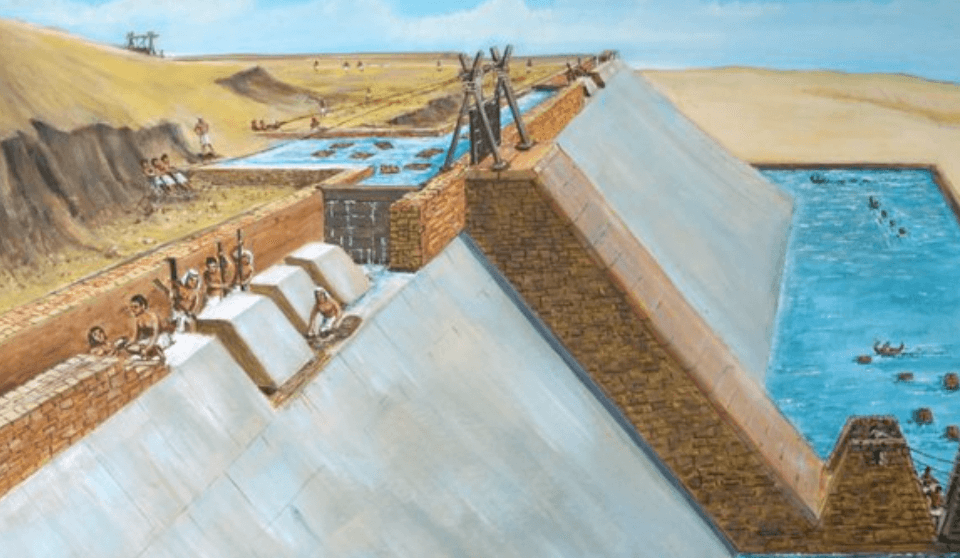
I also came across theories about the pyramids being built using buoyancy and water systems. There’s speculation about hydraulic lifts and water powered elevators, particularly for earlier structures like the Step Pyramid of Djoser.
The idea is interesting. Egypt had sophisticated water management. The Nile flooded annually. They understood hydraulics. Using water to assist in lifting heavy stones isn’t impossible.
But like every other theory, the evidence problem remains. Where are the canals? The water management infrastructure? The retaining walls? If they used water systems at this scale, there should be traces. Engineering on that level leaves marks.
Unless, again, they deliberately removed them. Which brings us back to the same uncomfortable realization: maybe the Egyptians were so thorough in erasing construction evidence that we’re looking for things that were intentionally eliminated.
None of these theories are definitive. When exploring pyramid construction, we need to consider all options. The external ramp has clear issues. The internal ramp probably isn’t there. The water theories lack infrastructure evidence. But the top down theory at least explains why the evidence is missing.
Why We Might Never Know for Sure
In math or hard science, proof is pretty absolute. You run the experiment, anyone can repeat it, and if the result holds, it’s true until someone disproves it.
But with archaeology, you can’t run a “build the Great Pyramid” live experiment. So instead, a theory gets stronger if it first predicts what we should find, and then on the ground, those predictions match the real traces. Different kinds of evidence start making sense under the same explanation.
With the pyramids, it’s even harder because we’re missing the entire construction phase. We can’t dismantle Khufu’s pyramid to see how it was built. Multiple methods could produce the exact same final shape.
So it’s less “this is absolutely true” and more “for now, this is the least wrong answer.”
The Uncomfortable Possibility
After digging into all of this, there’s a tiny part of me that kind of wanted to believe it was aliens. Not because I actually think that’s true, but because it would be simpler. It would close the loop. It would give us an answer, even if it’s a crazy one.
But that’s just cognitive closure talking. Our brains hate gaps in information. We’re wired to want explanations, even bad ones, rather than live with uncertainty.
Maybe that’s the whole point. In a world where we can Google almost anything, the pyramids are one of the last things we can’t force into clarity. And maybe if we understood them perfectly, they’d lose the thing that makes them extraordinary.
The top down theory is plausible. It explains the missing evidence better than anything else I’ve encountered. It matches Egyptian behavior patterns. It solves the apex problem elegantly. It accounts for the bonding stone patterns.
But it’s still just a theory. A well reasoned, carefully researched theory backed by thousands of hours of 3D modeling and analysis. But not proof.
We might never have proof. And maybe that’s okay.
The pyramids have been standing for over 4,500 years (or a lot, lot longer), longer than most civilizations have existed. They’ve outlasted empires. They’ve watched humanity evolve from bronze tools to spacecraft.
And they’re still keeping their secrets.
That’s something worth appreciating, even if it’s frustrating as hell.
At first I thought this was just another crazy theory from just another crazy pyramidiot, but it turns out to be very intriguing.
This was just a wonderfully interesting and educational read. I hadn't heard the top down theory before. Thank you.